

Introduction
On 3rd November 2025, the Federal Board of Revenue (FBR) issued S.R.O. 2071(I)/2025, introducing an important amendment in the Sales Tax Rules, 2006. This notification directly impacts retailers whose business activity involves withholding tax deduction under Sections 236G or 236H of the Income Tax Ordinance, 2001.
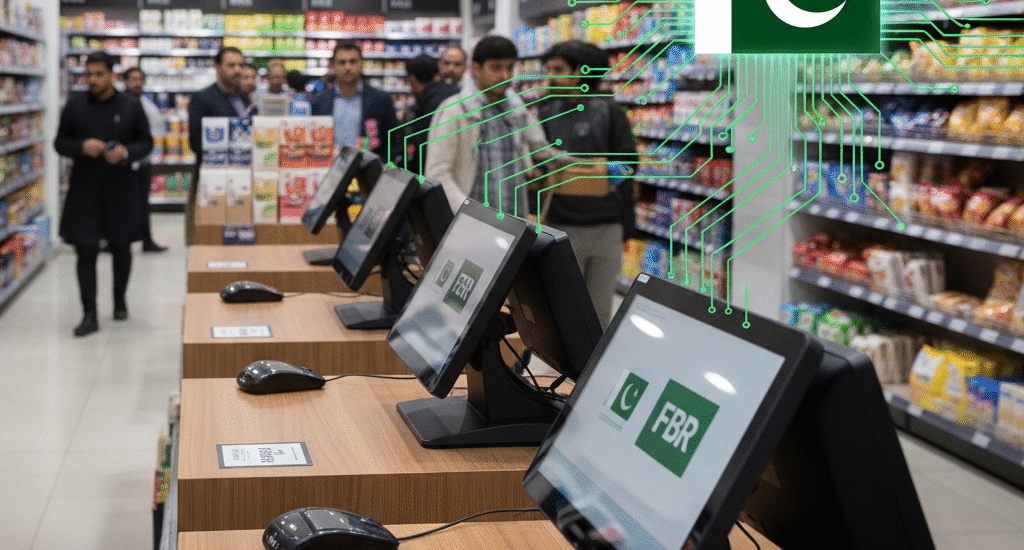
Through this amendment, FBR has strengthened the integration requirement for retailers with its Point of Sale (POS) or digital monitoring system, reinforcing Pakistan’s drive toward sales tax documentation and transparency.
Legal Reference — S.R.O. 2071(I)/2025 (Dated: 3rd November 2025)
Government of Pakistan — Revenue Division (Federal Board of Revenue)
Notification (Sales Tax)
S.R.O. 2071(I)/2025: In exercise of the powers conferred by section 50 of the Sales Tax Act, 1990 read with sections 22 and 23 thereof, the Federal Board of Revenue is pleased to direct that the following further amendment shall be made in the Sales Tax Rules, 2006, namely:
In the aforesaid Rules, in Rule 150Q, after sub-rule (2), the following new sub-rule shall be added, namely: —
“(3) Retailers whose deductible withholding tax under sections 236G or 236H of the Income Tax Ordinance, 2001 (XLIX of 2001) during the immediately preceding period exceeds one hundred thousand rupees or, as the case may be, five hundred thousand rupees, shall be required to integrate their business for the purposes of **clause (g) of sub-section (43A) of section 2 of the Sales Tax Act, 1990.”
Key Amendment Summary
| Clause | Particulars |
|---|---|
| Rule Amended | Rule 150Q of the Sales Tax Rules, 2006 |
| New Sub-Rule Added | Sub-rule (3) |
| Effective Authority | Federal Board of Revenue (FBR) |
| Effective Date | 3rd November 2025 |
| Legal Basis | Section 50 of the Sales Tax Act, 1990 |
| Affected Persons | Retailers with withholding tax deductions under Sections 236G or 236H |
| Integration Requirement Trigger | Deductible withholding tax exceeds PKR 100,000 or PKR 500,000 |
| Purpose | Integration of retail businesses with FBR’s electronic monitoring system |
Explanation of Sections 236G and 236H
Section 236G – Advance tax on sales to distributors, dealers, and wholesalers.
Section 236H – Advance tax on sales to retailers.
The S.R.O. 2071(I)/2025 links a retailer’s deductible withholding tax threshold under these sections with the mandatory integration requirement, creating a data-based enforcement criterion.
Integration Requirement — Clause (g) of Sub-section (43A) of Section 2 (Sales Tax Act, 1990)
Under this clause, “integrated business” refers to a retailer or entity whose electronic system is linked to FBR’s computerized system for real-time reporting of sales and invoices.
This integration enables:
Real-time sales data reporting to FBR;
Automatic invoice verification;
Transparent tax collection; and
Reduction in manual compliance and tax evasion.
Impact on Retailers
The amendment categorically brings large and medium retailers—based on their withholding tax exposure—into the mandatory integration net.
Retailers falling in these brackets must now ensure:
Integration with FBR’s POS System;
Proper maintenance of digital invoices;
Compliance with Rule 150ZEA for real-time reporting; and
Avoidance of penalties under Section 33 of the Sales Tax Act for non-integration.
Expected Benefits
Broader documentation of retail transactions;
Reduction in sales tax leakage;
Enhanced compliance monitoring;
Improved revenue transparency; and
Easier audit verification through centralized data.
Professional Insight
This notification forms part of FBR’s broader tax digitization and compliance strategy, which links income tax withholding with sales tax registration and integration.
It essentially bridges two major revenue streams — income tax under Sections 236G/236H and sales tax compliance — through data-driven enforcement.
FBR’s S.R.O. 2071(I)/2025 is a strategic move to ensure data-backed identification of large-volume retailers and compel their integration into the national sales tax monitoring system.
Businesses exceeding the specified withholding thresholds must act promptly to integrate with FBR’s POS or digital interface, failing which they may face suspension, penalties, or deregistration.
At Tanweer Habib & Co., we assist retailers and distributors in:
Assessing integration eligibility;
Executing FBR POS setup;
Filing sales tax returns under integrated systems; and
Managing tax reconciliation between Sections 236G/236H and monthly sales tax data.
FAQs on S.R.O. 2071(I)/2025
1. What is S.R.O. 2071(I)/2025?
It is an FBR notification issued on 3rd November 2025 amending Rule 150Q of the Sales Tax Rules, 2006 to mandate retailer integration.
2. When did the notification take effect?
It came into effect immediately upon issuance by FBR on 3rd November 2025.
3. What rule has been amended?
Rule 150Q of the Sales Tax Rules, 2006.
4. What new sub-rule was added?
A new sub-rule (3) linking retailer withholding tax levels to integration requirements.
5. What is the tax threshold for integration?
Retailers with deductible withholding tax exceeding PKR 100,000 or PKR 500,000 are required to integrate.
6. Which sections are referenced for withholding tax?
Sections 236G and 236H of the Income Tax Ordinance, 2001.
7. What does “integration” mean in this context?
It means linking a retailer’s POS system with FBR’s centralized monitoring system for real-time reporting of transactions.
8. Who must integrate under this S.R.O.?
Retailers meeting the withholding threshold under Sections 236G or 236H.
9. What is the objective of the amendment?
To strengthen sales tax documentation and improve tax transparency among high-volume retailers.
10. Which law empowers FBR to issue this notification?
Section 50 of the Sales Tax Act, 1990 authorizes FBR to make rules and amendments.
11. What happens if a retailer fails to integrate?
Non-integrated retailers may face penalties, deregistration, or enhanced audit scrutiny under the Sales Tax Act.
12. How is “deductible withholding tax” determined?
It is based on the tax deducted under Sections 236G and 236H during the immediately preceding tax period.
13. Are all retailers affected?
Only those exceeding the prescribed thresholds; small retailers remain unaffected.
14. Does this apply to wholesalers too?
Yes, if their sales activity is covered under Sections 236G or 236H and they meet the threshold limit.
15. What system must be used for integration?
Retailers must use the FBR-approved Point of Sale (POS) system under Rule 150ZEA.
16. Can integration be voluntary?
Yes, businesses below the threshold may voluntarily integrate for tax transparency benefits.
17. Will FBR provide technical assistance?
Yes, integration support and documentation are available on FBR’s official POS integration portal.
18. How does this benefit the retailer?
It provides audit ease, data security, and eligibility for reduced sales tax rates under integrated categories.
19. What records must integrated retailers maintain?
Sales invoices, POS data, daily transaction reports, and reconciliation with sales tax returns.
20. How can Tanweer Habib & Co. assist retailers?
We offer end-to-end integration support, POS compliance setup, and tax advisory services to help retailers stay fully compliant under FBR’s integration mandate.