
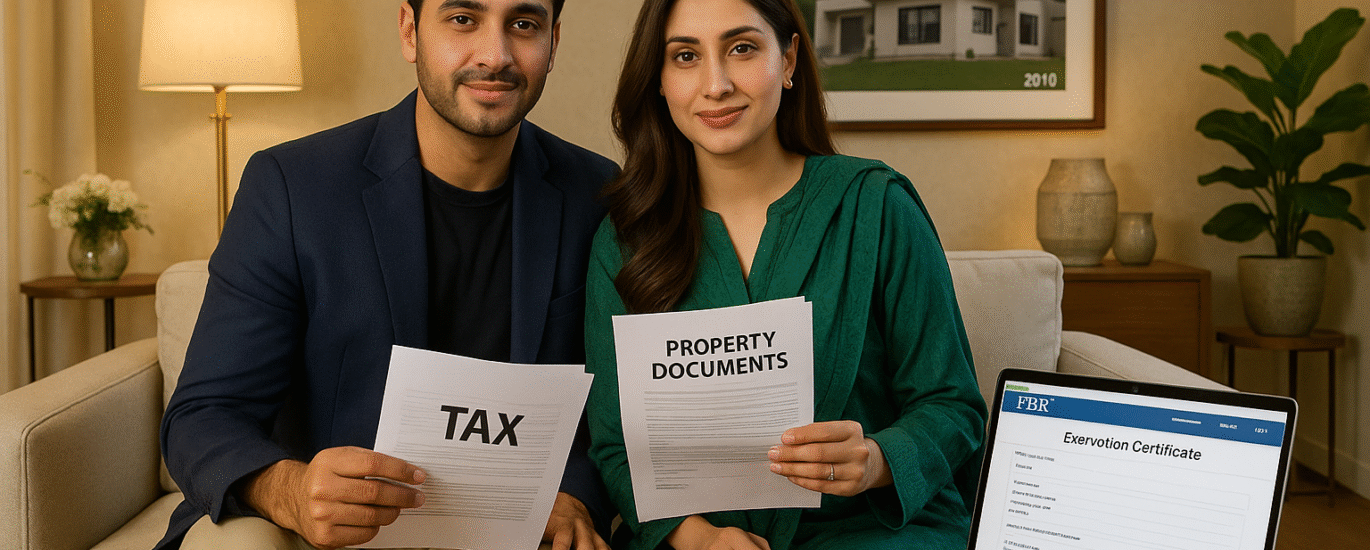
The Finance Act, 2025 brings much-awaited relief to long-term homeowners in Pakistan by inserting sub-section (1B) to Section 159 of the Income Tax Ordinance, 2001. If you’ve lived in a property for 15 years and declared it in your tax filings, you may now qualify for exemption from advance tax collected at the time of sale under Section 236C.
This article explains who qualifies, how to apply, and how to avoid unnecessary tax on selling long-held personal-use residential properties.
What Does the New Sub-Section 159(1B) Say?
A taxpayer can apply to the Commissioner for an exemption certificate from advance tax under Section 236C, if:
✅ The following 3 conditions are met:
Personal Use for 15 Years
The residential property has been in continuous personal use by the taxpayer for the last 15 years.
Declared in Wealth Statement
The property has been consistently declared in the wealth statement under Section 116 for the same period.
Tax Records Reflect Personal Residence
The property is marked as personal residential use in the FBR’s tax records.
📝 Key Restriction:
This exemption certificate can only be issued once every 15 years.
Practical Impact
Before this amendment, advance tax was automatically collected on every sale of property under Section 236C, regardless of use. Now, if your home meets the criteria, you can sell without paying this advance tax, which can be up to 5.5% of the sale value.
How to Apply for Exemption
To apply for the exemption certificate, you must:
Submit an Application
File in the prescribed format via IRIS or FBR-designated channel.
Attach Documents
CNIC
Copy of Wealth Statements for last 15 years
Evidence of personal residence, such as utility bills, address in return, etc.
Commissioner’s Approval
The Commissioner Inland Revenue will verify the information and issue an Exemption Certificate under Section 159(1B).
Important Notes
The exemption only applies to residential property.
It does not apply to commercial or rental property.
A person can only claim once in 15 years, so plan carefully.
If any one of the three conditions is missing, the application may be rejected.
20 FAQs About Section 159(1B) Exemption
Q1. What is Section 159(1B) about?
It allows exemption from advance tax under section 236C on the sale of a residential property used personally for 15 years.
Q2. What tax is being exempted?
Advance income tax collected at the time of sale of immovable property under Section 236C.
Q3. Is this applicable to rental or commercial property?
No, only to residential property used personally.
Q4. What is the minimum ownership period?
The property must have been in personal use for 15 years.
Q5. What kind of documentation is needed?
Wealth statements for 15 years, utility bills, and property ownership documents.
Q6. How many times can this exemption be claimed?
Only once every 15 years.
Q7. What if I lived in it for 14 years?
You will not qualify unless all 15 years are covered.
Q8. Who issues the exemption certificate?
The Commissioner Inland Revenue.
Q9. Can I sell without applying and later request a refund?
No, you must obtain the certificate before the sale.
Q10. Is there a deadline for applying?
Apply before registration or transfer of the property begins.
Q11. What if my property is jointly owned?
Each co-owner must meet the conditions individually.
Q12. Will my name be cross-checked in tax records?
Yes, FBR will verify personal-use status and declarations.
Q13. What if I didn’t file wealth statements in early years?
You may not qualify unless 15 consecutive years are filed.
Q14. What happens if my application is rejected?
You will have to pay advance tax under Section 236C as usual.
Q15. Does this mean I don’t need to report the gain?
No — this only exempts from advance tax, not from capital gains tax (if applicable).
Q16. Is there any fee for applying?
There is no official fee, but consultants may charge for preparing the file.
Q17. Can I authorize a tax consultant to apply?
Yes, through an authorization letter.
Q18. Will FBR issue a digital certificate?
Yes, typically through IRIS portal.
Q19. Will the exemption apply automatically?
No, only after the Commissioner approves and issues the certificate.
Q20. Is this facility available for Overseas Pakistanis?
Yes, if they fulfill all conditions and have filed wealth statements.